




Future-proof plants

#process innovation

Process innovation has always been at the heart of ACHEMA – and is more relevant than ever. Innovations in chemical, pharmaceutical or biotechnological processes are providing new answers to today’s challenges. At the same time, it is becoming increasingly demanding to optimise the operation of existing plants and keep them competitive.

Spotlight on #process innovation at ACHEMA 2027

The ACHEMA #process innovation theme brings together the key players from chemical, pharmaceutical and food processing industries:

  • Plant Owners / Operators
  • Process Engineering
  • Technical Services
  • Site Management
  • Procurement
  • Continuous Improvement
  • Energy & Utility

The hot topics of the process industries:

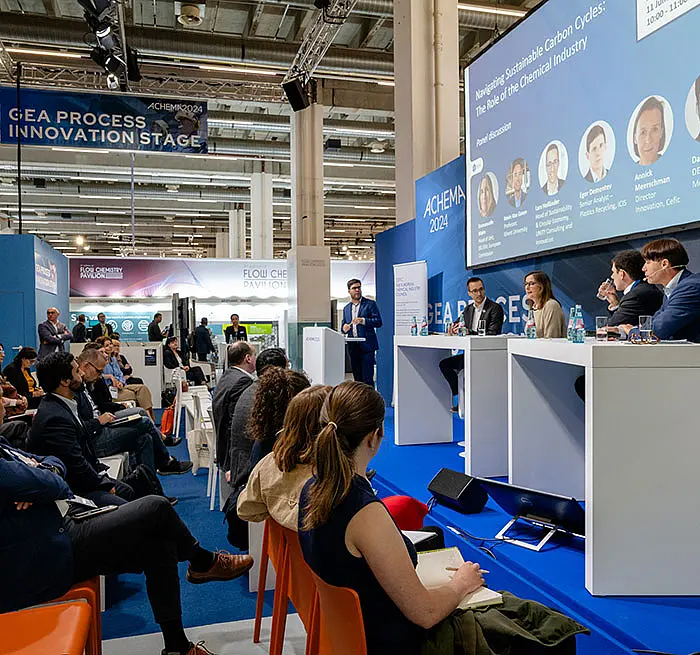
The Process Innovation Stage will zoom in on the current hot topics helping transform the industry: 

  • Electrification, flexibilisation and efficiency improvement of chemical processes
  • New food processing and technology
  • Smart engineering, equipment, analytics and operations
  • Advanced and sustainable production and reaction systems

Discover the latest technical developments

#process innovation is at the heart of ACHEMA – true to Max Buchner’s vision of bridging the gap between chemists in the lab and engineers on the factory floor.

This enduring and inspiring connection is reflected in our exhibition groups. To name a few:

Engineering and Energy

Laboratory- and Analytical Techniques

Mechanical Processes

Pumps, Valves and Materials

Industrial and Labour Safely

Thermal Processes

The ACHEMA Congress

As an essential part of ACHEMA, the congress is fully integrated into the exhibition programme and meeting place for researchers, developers, expert users and visionaries. The six Innovation Themes form the overarching framework for the congress programme. 

Submissions are accepted until 4 October 2026.

For #process innovation, you can submit a paper on one of the following topics:

#process innovation

#process: Modular production

Modular production — from skid-based unit operations to standardised plant modules (Process Equipment Assemblies) and modular automation following the Module Type Package (MTP) approach — is redefining how process plants are designed, deployed, and adapted. Pressure to respond to shifting feedstocks, variable demand, and faster time-to-market makes modular architectures increasingly attractive for capital efficiency and operational flexibility. Contributions are sought on engineering frameworks, integration standards, automation interfaces, scale-up experience, and industrial deployment cases across the chemical and life science industries.

  • Modular production
  • Modular automation concepts
  • Module Type Package (MTP)
  • Skid-based processes
  • Process plant flexibility
  • Capital efficiency
  • Integration standards

#process: Plant design and maintenance

To keep existing plant assets safe, efficient, and competitive, continuous improvements in plant design and maintenance practices are essential. In the chemical and life sciences process industries, an aging infrastructure, evolving regulatory requirements, and the integration of new process equipment into existing facilities are transforming lifecycle management. We invite submissions on condition monitoring, inspection technologies, corrosion management, plant modernization, reliability engineering, and maintenance strategies that extend plant service life or improve operational performance.

  • Asset lifecycle management
  • Plant revamping
  • Condition monitoring
  • Corrosion management
  • Reliability engineering
  • Inspection technologies
  • Maintenance strategies

#process: Materials and material processing

The selection of materials and the corresponding processing technology are central to the performance, safety, and competitiveness of chemical, pharmaceutical and life science production processes and process engineering. Improved structural and functional materials, active ingredients, surface treatment, corrosion-resistant alloys, polymers, and ceramics each can help to overcome specific challenges to each process, especially in aggressive process environments. Submissions are welcome, focussing on materials for synthesis, characterization, forming and joining techniques and its engineering, coating processes, and the qualification of materials for new or retrofitted plants as well as repairing scenarios— with an emphasis on high performance under industrial operating conditions and transformation processes.

  • Materials for high temperature
  • Corrosion-resistant materials
  • Surface treatment & coatings
  • Polymers and ceramics in process equipment
  • Material characterization and qualification
  • Forming and joining techniques

#process: Process engineering

Process engineering forms the foundation for the design, optimization, and scaling of production systems in the chemical industry and the life sciences. As existing plants face pressure to accommodate new feedstocks, stricter efficiency targets, and evolving regulatory standards, advances in reactor design, separation technology, heat and mass transfer, and process intensification are becoming increasingly urgent for the industry. We invite submissions on the topics of unit operations, reaction engineering, process simulation, and scale-up studies that address the performance and adaptability of current and future production facilities.

  • Unit operations
  • Reactor design
  • Separation technology
  • Process intensification
  • Heat and mass transfer
  • Process simulation
  • Scale-up

#process: Bioprocess engineering

As demand for biologically derived compounds grows and new facilities come on stream, optimising bioreactor design, upstream and downstream processing, and scale-up methodology is increasingly critical. Submissions are invited on fermentation technology, bioseparation, process analytical technology, and strategies to improve yield, robustness, and reproducibility in industrial bioprocesses. 
Contributions from the biopharmaceutical sector may fit the topics #pharma.

  • Bioreactor design and technology
  • Upstream and downstream processing
  • Bioseparations
  • Process analytical technology (PAT), ML/AI
  • Scale-up 

#process: Food processing and technology

Food processing and technology sits at the intersection of well-established unit operations and evolving process engineering demands. As requirements for product safety, resource efficiency, and manufacturing flexibility intensify globally, the sector is updating its installed asset base through improved thermal and non-thermal processing methods, continuous manufacturing approaches, and advances in hygienic equipment design. Contributions are invited on process scale-up, equipment integration, operational efficiency, and the industrial deployment of novel processing technologies.

  • Thermal and non-thermal processing
  • Hygienic equipment design
  • Continuous manufacturing
  • Process scale-up
  • Manufacturing flexibility
  • Food safety and regulatory compliance

#process: Process innovation in Life Sciences

Keeping existing assets competitive while deploying next-generation unit operations demands rigorous engineering and cross-disciplinary collaboration. Contributions are sought on continuous manufacturing, process intensification, facility design, and technology transfer across the biotechnology sectors.
Contributions from the biopharmaceutical sector may fit the topics #pharma.

  • Continuous bioprocessing
  • Process intensification
  • Quality by design
  • Technology transfer
  • Facility design

#process: Innovative mixing & separation solutions

Mixing and separation operations are at the very heart of chemical, pharmaceutical, and life science plants worldwide. As the installed equipment ideally performs at benchmark efficiency, innovations in mixing-, separation-, and hybrid process configurations help to preserve and push forward what is technically and economically achievable. Contributions are welcome on novel unit operation designs, scale-up of advanced separation concepts, intensified mixing strategies, and integration of new equipment into existing plant infrastructure.

  • Treatment, mixing and separation of liquids, solids and gases
  • Separation and filtration technologies
  • Mechanical processes
  • Thermal processes
  • Hybrid separation processes
  • AI-guided mixing and separation processes

#process: Fluid handling

Pumps, valves, seals, and piping systems form the infrastructure of every process plant. Their reliability is critical to operational continuity. As plants face increasing pressure to maximize performance, advancements in sealing technology, pump design, and valve technology are transforming maintenance strategies and lifecycle cost-effectiveness. We invite submissions on the topics of plant innovation, sealing technology, condition monitoring, materials development, and the integration of fluid handling systems into demanding process environments.

  • Pump technology
  • Valve engineering
  • Sealing solutions
  • Condition monitoring
  • Asset reliability
  • Hygienic design
  • Piping systems

#process: Safety and security

Safety and security are non-negotiable foundations of every process plant, and requirements grow more demanding as plant configurations evolve and the threat landscapes broaden. From functional safety and process hazard analysis to plant security and the protection of critical infrastructure, the discipline spans engineering, regulation, and operational practice. Contributions are invited on risk assessment methodologies, inherently safer design, learning from incidents, as well as process safety and security across the full plant lifecycle.

  • Process hazard analysis (PHA)
  • Risk management
  • Functional safety
  • Safety instrumented systems (SIS)
  • Safe and sustainable by design
  • Plant and process security

Industry Insights

The life science and process industries are constantly evolving: new challenges, the latest research results and innovative technologies and products are always on the agenda. 

That is why we want to keep you up to date with our news and articles on process innovation.

To the article overview

Watch highlights from ACHEMA and the latest industry trends in our media library.

To the Media Library

Tickets
Contact