





07/24/2026 | Pharma Innovation
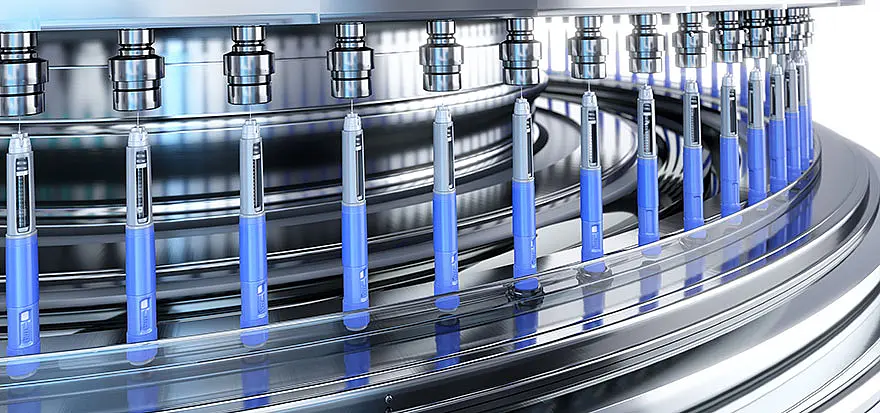
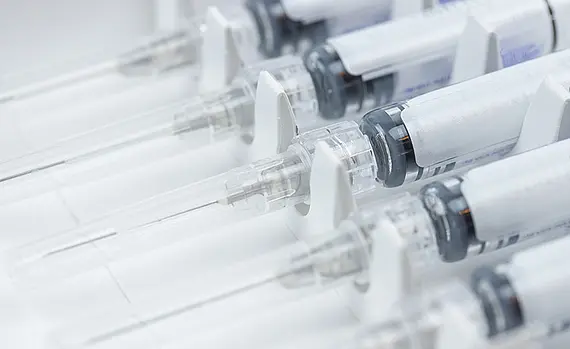
The pharmaceutical industry’s new blockbusters no longer come solely from the tablet press. They are found in pre-filled syringes, cartridges, pens and autoinjectors – and they present packaging technology with a seemingly contradictory challenge: it must process millions of doses cost-effectively whilst also being prepared for small, high-value batches. High throughput and flexibility, standardisation and customisation, maximum safety and short changeover times must all be reconciled in a single investment decision today.
As a result, the landscape has shifted significantly since the last ACHEMA. In 2024, pharmaceutical packaging was still under the shadow of the Covid-19 pandemic: vials, vaccines, cold chains, rapid project delivery and additional capacity dominated the discussion. Even today, demand for medicines continues to grow – yet the drivers of this growth are coming from very different directions.
On the one hand, GLP-1 preparations for diabetes and obesity are driving entirely new high-volume markets. On the other hand, biologics, oncology drugs, highly potent active substances, and cell and gene therapies are gaining in importance. Many of these products are sensitive, expensive, require sterile processing and are manufactured in smaller batches. Furthermore, the commercial success of new therapies is becoming increasingly difficult to predict.
The consequence is that production facilities today must be designed to be significantly more flexible than they were just a few years ago. What begins in the upstream phase with more variable manufacturing processes inevitably continues into the downstream phase. Packaging is therefore no longer merely the final step after production but is evolving into a strategic component of pharmaceutical value creation.
It is therefore no surprise that pharmaceutical packaging technology remains one of the most dynamic segments of the pharmaceutical machinery sector. According to estimates by Grand View Research, the market for pharmaceutical packaging machinery is set to grow from around US$7.5 billion in 2026 to just under US$12.7 billion in 2033. This corresponds to an average annual growth rate of 7.8 per cent. MarketsandMarkets defines the market somewhat more broadly and forecasts growth in the pharmaceutical packaging equipment sector from US$10.6 billion in 2025 to US$14.3 billion by 2030.
Although the figures differ in detail, their message is clear: investment in packaging and fill-and-finish technologies is growing faster than the pharmaceutical market as a whole. However, the reason for this is no longer solely down to additional production volumes. Technical complexity is constantly increasing. Annex 1-compliant aseptic processes, ready-to-use packaging materials, digital documentation, serialisation, more sustainable packaging materials and the desire for higher plant availability are driving investment just as much as new forms of therapy.
The market is shaped by a small number of leading international specialists. Companies such as Syntegon, IMA, Bausch+Ströbel, Groninger and Optima dominate the field of aseptic primary packaging and fill-and-finish systems. Uhlmann, Schubert Pharma and Harro Höfliger focus more strongly on blister, cartoning and secondary packaging, as well as the integration of complete packaging processes. What all manufacturers have in common is that they are increasingly evolving from traditional machine suppliers into providers of complete production platforms – including software, data integration and lifecycle services.
Geopolitical developments are providing the market with further momentum. The US is promoting the development of local production capacity through investment programmes and announced tariffs on imported medicines. At the same time, the European Union is pursuing the aim, through the Critical Medicines Act, of securing the supply of critical medicines more firmly within Europe once again. For manufacturers of fill-and-finish and packaging technology, this means additional investment in production capacity on both sides of the Atlantic.
This shift is particularly evident in the field of injectables. Even before the pandemic, machinery manufacturers had noted rising demand for pre-filled syringes. Covid-19 led to a temporary resurgence in the use of traditional vials, as large quantities of vaccine had to be made available quickly. Now, however, the importance of ready-to-use (RTU) packaging is growing significantly once again: RTU syringes, RTU vials and cartridges reduce the risk of contamination, simplify dosing and are well-suited to a pharmaceutical landscape in which self-administration and patient-friendly dosage forms are becoming increasingly important.
The GLP-1 boom is reinforcing this trend. Weight-loss injections and diabetes medicines require high volumes in pens, cartridges or pre-filled syringes. At the same time, many operators do not want to commit their facilities exclusively to a single product. Anyone ordering a production line today must expect that, in five years’ time, a different format, a different filling process or a different therapeutic class will take centre stage.
This conflict of objectives is made even more acute by personalised medicine. Such products involve patient-specific doses of extremely high value. The packaging machine thus serves as insurance against an uncertain product pipeline. No one knows whether millions of syringes or just a few hundred patient-specific units will be needed tomorrow. Manufacturers are responding to this with platforms and product families: small, highly flexible systems for clinical batches and personalised therapies; medium-sized systems for changing product ranges; and high-performance lines for volume markets.
This trend is now evident among almost all leading manufacturers. With its Flexcare platform, Groninger aims to combine stable aseptic processes with a high degree of adaptability. Harro Höfliger focuses on modular platforms – ranging from flexible cartoning machines and cobot-assisted magazine loading to containment solutions for highly active ingredients. Schubert Pharma, for its part, addresses secondary packaging with top-loading technology, TLM platforms and scalable solutions for different formats and output ranges.
The trend is clear: flexibility is no longer seen as an additional feature but is becoming a key design criterion for new packaging lines.
The revised EU GMP Annex 1 is shaping technical development even more significantly than in 2023. Back then, the revision had only just been finalised; today, it is being interpreted in concrete terms during audits and inspections – and, according to insiders, much more strictly than most pharmaceutical manufacturers had anticipated. For operators, this means they must not only explain why a risk is manageable; they must increasingly demonstrate how critical interventions can be technically prevented.
This shifts the focus in aseptic primary packaging. Manual interventions inside isolators, the manual handling of parts that come into contact with the product, open airlock processes or unfavourable airflows are coming under scrutiny. As harsh as it may sound, humans are considered the greatest source of contamination in the sterile core process. The answer lies in more closed systems, more automation, more robotics and more monitoring.
Bausch+Ströbel accordingly describes Annex 1 as one of the key issues at present. The company has developed risk analyses for new and existing facilities and offers workshops to customers to identify potential Annex 1 breaches. Where a deviation can no longer be scientifically justified, a technical solution is required – for example, through modified parts handling, improved airlock processes or modifications to existing lines.
As a result, Annex 1 is also becoming a driver of investment in existing facilities. This is because many pharmaceutical plants operate for 20 or 30 years. Those who placed orders five years ago were often unable to take full account of the authorities’ current interpretation at the time. Operators must now demonstrate how they will gradually bring existing lines up to a higher safety standard. The challenge here is not only regulatory but also economic: more technology increases investment costs, whilst at the same time aiming to reduce deviations, downtime and product risks.
Annex 1 is by no means an exclusively European issue. Whilst the regulatory framework formally forms part of the EU GMP guidelines, the virtually identical PIC/S Annex 1 now serves as a reference for GMP inspections in numerous major pharmaceutical markets. Regulatory authorities such as the FDA in the USA and the Japanese PMDA base their assessment of aseptic processes on comparable fundamental principles, also and even China is gradually aligning with international standards now its requirements for sterile medicinal products. For pharmaceutical manufacturers operating globally, this means that packaging lines must no longer merely comply with national regulations but must also meet an increasingly harmonised understanding of aseptic production and contamination control.
The most visible consequence of this development is the trend towards glove-free isolators. What seemed like a vision of the future just a few years ago is now being translated into concrete production line concepts. The real paradigm shift lies not so much in the robotics themselves as in the operator’s new role. In future, the operator should, as far as possible, no longer need to enter the core aseptic process or influence it through manual interventions. Interventions are prepared, automated or carried out entirely outside the isolator.
Syntegon is pursuing this approach with its new SynTiso fill-and-finish platform. The system combines robotised material flow with contactless transport technology and processes RTU syringes, vials and cartridges on a single platform. According to the company, this reduces batch changeover times by up to 50 per cent; at the same time, the fully integrated in-process control enables output rates of up to 600 containers per minute.
This concept is complemented by RackSter, a steam-sterilisable multi-rack containment system for the automated transfer of sterile components into the isolator. Up to 90 per cent fewer docking operations mean not only shorter changeover times, but also less manual handling – and thus a lower risk of contamination.
Bausch+Ströbel is also driving this development forward. The path leads from open access, via RABS and isolators, to closed, robot-assisted processes. This applies to small batches as well as high-throughput lines. The key is not to use the same technology everywhere, but to remove people from the process where they pose the greatest risk of contamination.
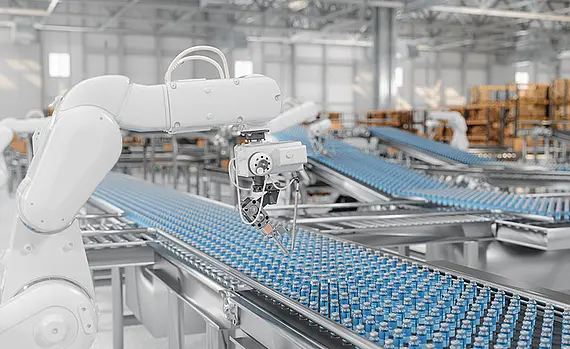
This is also fundamentally changing the role of robotics. For a long time, its use in pharmaceutical packaging was limited to traditional end-of-line tasks such as cartoning, palletising or product insertion. Today, it is gradually making its way into the core aseptic process. There are several reasons for this. In addition to the increased requirements of Annex 1, a shortage of skilled workers and rising labour costs are making it more difficult to operate traditional cleanroom processes. At the same time, smaller batches and more frequent product changes mean that packaging lines must become more robust and quicker to changeover.
Robots are therefore increasingly taking on tasks that, until a few years ago, were reserved exclusively for operators. They remove syringes from RTU tubs, move containers through isolators, insert stoppers, assist with camera-based inspection processes or automate line clearance. The benefit lies less in higher cycle rates than in reproducible processes, a lower risk of contamination and consistent process quality.
IMA summarises this development under the guiding principle of ‘Cognitive Manufacturing’. Most recently, the group presented an approach combining autonomous robotics, AI-supported interaction, digital services and materials development. For the pharmaceutical sector, IMA Life’s TILE-X is particularly relevant: a fill-finish line for ready-to-use components based on magnetic levitation technology. It is designed to enable frictionless handling without particle generation and is intended for use, particularly with high-value biopharmaceuticals, ATMPs and in cell and gene therapies.
Optima focuses on a related but often underestimated aspect: product yield. Particularly with expensive biopharmaceuticals and orphan drugs, it is not only the speed at which a line runs that matters, but also how much active ingredient is lost during start-up, format changes or due to improper handling. With the format-independent FillCell transport system, Optima addresses precisely this issue. The aim is to prevent product losses during start-up and to route packaging materials through the machine more flexibly.
What these developments have in common is a fundamental shift in perspective: robotics is no longer primarily used to reduce staffing levels. It is becoming a key technology for making aseptic processes more reproducible, safer and, at the same time, more cost-effective.
Whilst robotics is transforming the physical process, the digital aspect of packaging technology is evolving in parallel. Three years ago, the focus was often still on OEE visualisation, recipe management, MES interfaces or operator training. Today, digital twins, condition monitoring, assistance systems and AI-supported fault diagnosis are becoming increasingly integrated into day-to-day operations. This increasingly requires standardised data interfaces such as OPC UA or PackML, through which machines from different manufacturers can work together seamlessly. With PacXplorer, Uhlmann, in collaboration with SAP, is demonstrating how packaging machines, digital twins, condition monitoring, smart services and interoperable data spaces can be integrated into business processes. Groninger is presenting VisionX Pink, a digital ecosystem designed to make machine data transparent, highlight deviations at an early stage and support operators with digital guidance.
Alongside robotics and digitalisation, another aspect is gaining in importance: sustainability. This shift was already becoming apparent in the run-up to ACHEMA 2024. It is now becoming clearer, however, just how complex this issue in pharmaceutical packaging actually is. Unlike with consumer goods packaging materials in the pharmaceutical industry cannot be interchanged at will. Any change to primary packaging materials can affect the stability, sterility or regulatory approval of a medicinal product. Sustainability is therefore no longer limited to the choice of a new material. It encompasses the entire packaging chain – from the packaging material itself, through the machinery, to transport and logistics.
This development is particularly evident in secondary packaging. Uhlmann, for example, aims to replace plastic wherever paper can provide the same level of product protection. With the new Slim Cardboard Trays, syringes, vials, ampoules or auto-injectors can be packaged in significantly more compact cardboard trays. not only on materials. According to the company, as well as saving on materials, this also increases the number of products per pallet by up to 60 per cent. Less material, smaller volume and more products per pallet not only reduce CO2 emissions but also cut transport and storage costs.
The market is also evolving in the field of blister packs. PP blister packs and mono-PET films are designed to improve recyclability without compromising stability, barrier properties or machine runnability. Uhlmann, Faller Packaging, Perlen Packaging and Etimex have tested PP pharmaceutical blister packs on a blister packaging machine under realistic conditions. IMA is demonstrating high-speed blister packaging using mono-PET film. The direction is clear: sustainable pharmaceutical packaging is not achieved through a single ‘green’ packaging material, but through the interplay of material, machinery, process window, validation and the supply chain.
Labelling technology is also evolving. After years in which serialisation and anti-counterfeiting were the main priorities, digital and functional added value is now coming more into the spotlight: NFC labels, RFID, battery-free sensors, electronic package leaflets or smart labels that provide visibility of storage conditions and temperature effects. Packaging thus becomes part of the quality assurance process right through to the patient.
Since 2023, pharmaceutical packaging technology has not reinvented itself, but its focus has shifted significantly. What was once a question of capacity has now become a systemic issue: new forms of therapy, the GLP-1 boom, personalised medicine, Annex 1, sustainability and digital integration now set the agenda. Machine manufacturers’ responses are modular, robotics-supported, data-driven and increasingly autonomous.
The trend is clear: it is no longer the individual machine that determines a production line’s performance, but the interplay between packaging materials, process, robotics, software, data and service. The current state of this interplay can be assessed first-hand in 2027: at ACHEMA in Frankfurt, glove-free isolators, magnetic transport systems, AI-supported assistance and retrofit concepts for existing equipment will be on display together – not as a roadmap, but as operational technology. For operators, the trade show thus becomes a testbed for a simple question: which platform safeguards an investment when no one can predict whether millions of pens or a few hundred patient-specific doses will pass through the line tomorrow?
Author
Chemical engineer and freelance trade journalist
Process Innovation
Newsletter
With our newsletter you will receive current information on ACHEMA on a regular basis. You are guaranteed not to miss any important dates.
Theodor-Heuss-Allee 25
60486 Frankfurt am Main
Tel.: +49 69 7564-100